Role of Ai in HR
Introduction
Employee engagement and experience have become essential priorities for modern organizations. Employees today expect more than a salary; they want meaningful work, professional growth, recognition, flexibility, and a positive workplace culture. Meeting these expectations requires HR professionals to understand employee needs and respond effectively.
This is where Artificial Intelligence (AI) in Human Resource Management is making a difference. From personalized learning recommendations to AI-powered employee feedback tools, organizations are using technology to create more responsive and engaging workplaces.
AI does not replace the human side of HR. Instead, when used responsibly, it helps HR professionals identify patterns, reduce administrative workloads, and spend more time building relationships with employees.
In this article, we explore how AI is transforming employee engagement and experience, its practical applications, its benefits and challenges, and how organizations can implement it effectively.
What Is Artificial Intelligence in Human Resource Management?
Artificial Intelligence in Human Resource Management refers to the use of AI-powered technologies to support HR activities such as recruitment, onboarding, employee communication, performance management, learning, and workforce planning.
These technologies can analyze information, identify patterns, generate recommendations, and automate repetitive tasks. Examples include HR chatbots, employee sentiment analysis tools, intelligent learning platforms, and AI-assisted HR analytics.
For employee engagement, the primary goal is to understand what employees need and help organizations create a supportive, productive, and inclusive work environment.
1. Personalized Employee Experience
Every employee has different career goals, learning preferences, and workplace expectations. A single approach to employee engagement may not work equally well for everyone.
AI can help HR teams personalize employee experiences by analyzing relevant information, such as employee-selected learning goals, skills, feedback, and career interests.
For example, an employee interested in leadership development could receive recommendations for communication courses, mentoring opportunities, and management training. Another employee looking to improve technical skills could receive suggestions for relevant certifications.
This personalization can make employees feel supported and help them take greater ownership of their professional development.
However, organizations should use employee information transparently and avoid making assumptions about individuals based solely on automated predictions.
2. Improving Employee Feedback and Sentiment Analysis
Traditional employee surveys often provide valuable information, but HR teams may struggle to analyze hundreds of responses quickly.
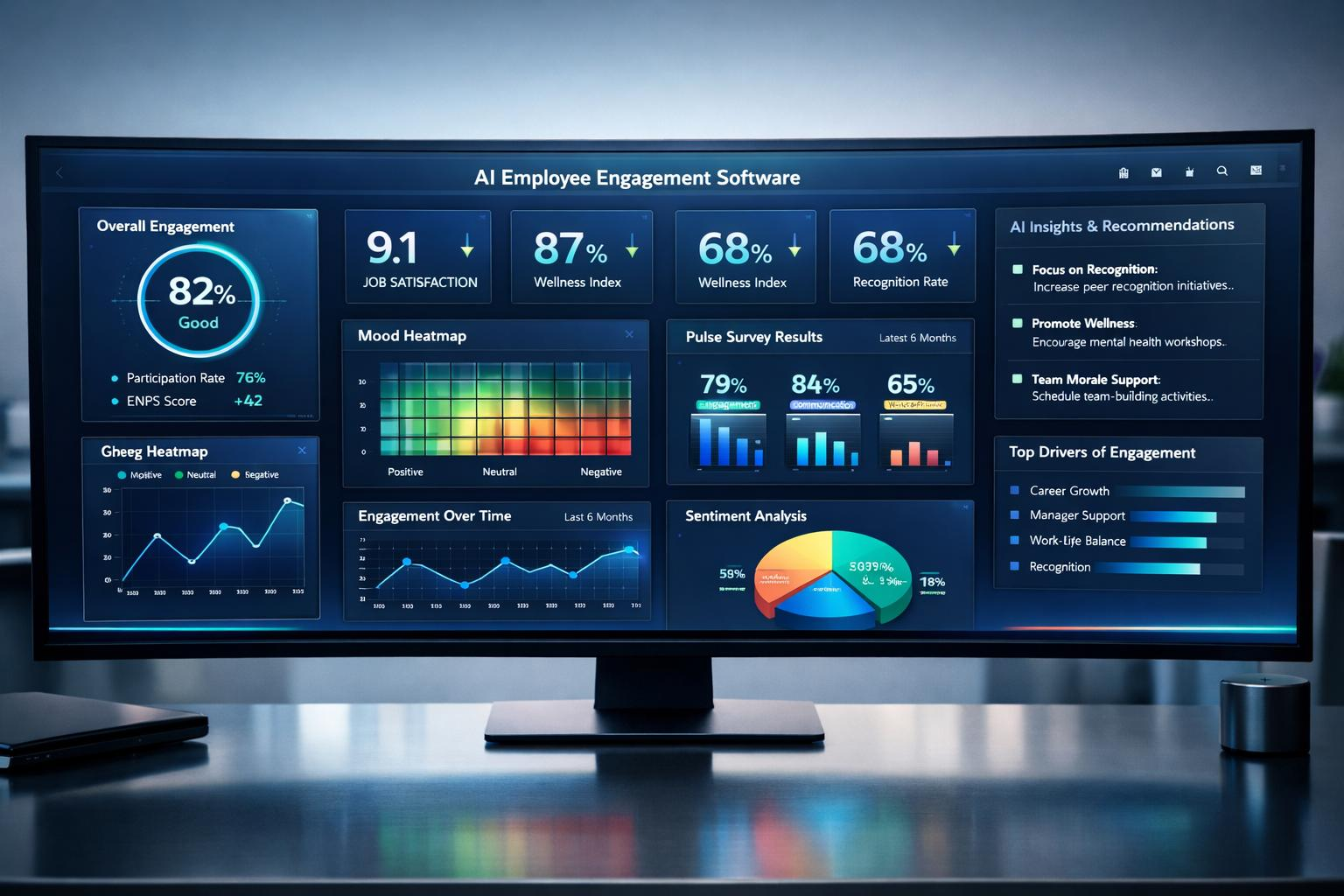
AI-powered text analysis tools can help summarize survey comments, identify recurring themes, and highlight common concerns related to workload, communication, management support, or workplace culture.
For example, if employees repeatedly mention unclear project expectations in anonymous feedback, HR can investigate the issue and work with managers to improve communication.
AI can also help organize feedback collected through pulse surveys and employee experience platforms, allowing HR teams to identify emerging trends more efficiently.
Important consideration: Sentiment analysis is not always accurate. Sarcasm, cultural differences, language variations, and personal communication styles can affect results. AI-generated insights should guide further investigation rather than determine how an individual employee feels.
3. AI-Powered HR Chatbots and Employee Support
Employees frequently need quick answers to routine HR questions about leave policies, attendance, payroll schedules, benefits, company holidays, and internal procedures.
AI-powered HR chatbots can provide information around the clock, helping employees access approved policies without waiting for an HR representative to respond.
For example, an employee who wants to understand the leave application process could ask the company chatbot and receive the relevant policy and application instructions.
This reduces repetitive queries for HR teams and allows them to focus on more complex responsibilities, including grievance handling, conflict resolution, employee counseling, and workplace development.
To remain effective, chatbots should use accurate, regularly updated information and provide an easy way to contact a human HR representative when a question requires judgment or confidentiality.
4. Better Employee Onboarding and Integration
The onboarding experience strongly influences how new employees understand an organization and settle into their roles.
AI can support onboarding by providing personalized checklists, answering frequently asked questions, recommending training resources, and reminding new employees about important tasks.
For example, a new marketing executive might receive a structured onboarding plan covering company policies, marketing tools, team introductions, reporting procedures, and role-specific training.
HR teams can also use onboarding feedback to identify recurring problems, such as unclear responsibilities or delays in providing access to essential tools.
A well-designed onboarding process helps new employees feel welcomed, informed, and prepared to contribute.
5. Supporting Learning, Career Growth, and Retention
Professional development is an important part of employee experience. Employees are more likely to remain motivated when they can see opportunities to learn and progress.
AI-powered learning platforms can recommend courses based on employees’ skills, career goals, and identified development needs. Workforce analytics can also help HR teams identify skills gaps across departments.
For example, if a company plans to expand its digital marketing team, HR can identify relevant skill requirements and recommend training in SEO, analytics, content strategy, and AI-assisted marketing tools.
AI may also help identify organizational patterns associated with employee turnover, such as limited development opportunities or repeated engagement concerns.
However, AI predictions should never be treated as proof that a particular employee intends to resign. HR professionals should use these insights to investigate workplace issues, conduct appropriate conversations, and improve retention strategies without unfairly profiling employees.
6. Data-Driven Performance Management and Recognition
AI can help managers organize performance information, summarize feedback, identify training needs, and support more structured performance discussions.
For instance, a manager preparing for an appraisal could use an approved AI tool to organize documented achievements, project contributions, and agreed development goals into a discussion outline.
AI can also help HR teams design recognition programs by highlighting documented accomplishments and identifying opportunities to celebrate employee contributions.
Nevertheless, performance decisions should consider context, individual circumstances, measurable outcomes, and human judgment. AI should not independently determine promotions, salary increases, disciplinary action, or termination decisions.
Organizations must also ensure that employees have opportunities to correct inaccurate information and challenge unfair assessments.
Benefits of Using AI to Improve Employee Engagement
When implemented thoughtfully, AI can offer several benefits:
- Faster HR support: Employees can access routine information without unnecessary delays.
- Personalized development: Learning opportunities can better match individual goals and skill requirements.
- Actionable feedback: HR teams can identify recurring workplace concerns more efficiently.
- Improved onboarding: New employees receive structured guidance and timely reminders.
- Better workforce planning: HR professionals can identify organizational trends and potential skills gaps.
- More time for human interaction: Automation reduces repetitive work, allowing HR teams to focus on employee relationships and workplace culture.
These benefits depend on the quality of the tools, the information available, and how responsibly organizations use the technology.
Challenges and Ethical Considerations
Despite its advantages, AI in HR introduces important challenges.
Data privacy: Employee information must be protected through appropriate access controls, secure systems, and clear data-use policies.
Bias and fairness: AI systems may reproduce historical biases or produce unfair recommendations. Organizations should test tools for discriminatory outcomes and review important decisions.
Lack of transparency: Employees should understand when AI is being used, what information it processes, and how its recommendations may affect them.
Over-automation: Excessive reliance on automated systems can make employees feel monitored or disconnected from HR. Sensitive concerns require empathy, confidentiality, and human attention.
Accuracy: AI-generated summaries and recommendations can contain errors. HR professionals must verify important information before acting on it.
Responsible implementation requires human oversight, employee communication, regular evaluation, and clear accountability.
How HR Teams Can Implement AI Successfully
Organizations do not need expensive enterprise software to begin exploring AI. HR teams can start with small, low-risk applications.
- Identify a genuine problem: Begin with repetitive HR queries, onboarding documentation, or employee survey summaries.
- Choose an appropriate tool: Evaluate data protection, reliability, cost, integration, and ease of use.
- Establish clear policies: Define what employee data can be processed and which decisions require human approval.
- Train HR professionals: Teach teams how to use AI responsibly, verify outputs, and recognize potential bias.
- Communicate with employees: Explain the purpose of AI tools and provide channels for questions or concerns.
- Measure results: Track indicators such as response time, onboarding satisfaction, employee feedback, and participation in learning programs.
Starting small allows organizations to test value, address concerns, and improve implementation before expanding AI use.
Conclusion
Artificial Intelligence is creating new opportunities to improve employee engagement and experience. It can help HR professionals personalize learning, provide faster support, understand feedback, improve onboarding, and identify workplace trends.
However, technology alone cannot create an engaged workforce. Employees still need trust, recognition, fair treatment, meaningful communication, and supportive leadership.
The most effective approach combines AI-driven insights with human empathy and professional judgment. For HR professionals, the goal is not to automate every interaction but to use technology to make those interactions more meaningful.
As organizations continue to adopt AI, the future of HR will depend on balancing innovation with privacy, fairness, transparency, and genuine care for employees.